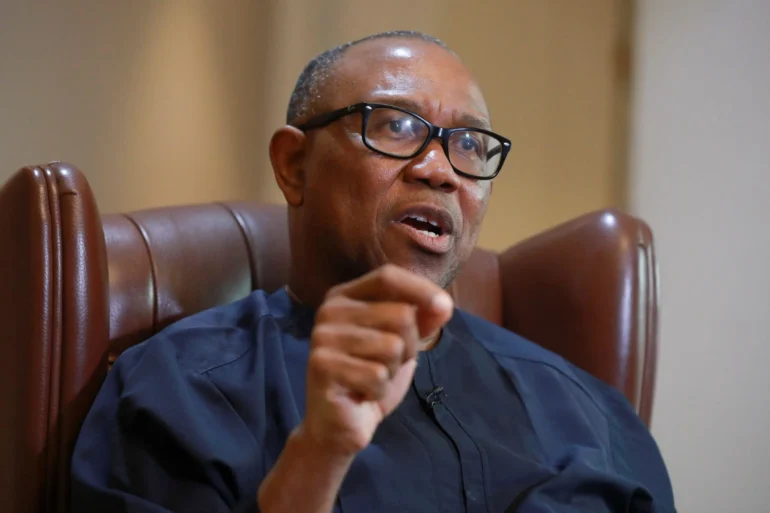
Former Labour Party presidential candidate, Peter Obi, has criticised the House of Representatives over its refusal to criminalise vote-buying at the level of party primaries, describing the decision as a setback for Nigeria’s democratic development.
Obi expressed his views in a post on X (formerly Twitter) on Sunday, reacting to the ongoing amendments to the Electoral Act, 2022, being considered by the House of Representatives.
He said many Nigerians had expected lawmakers to take a firm stance against vote-buying, which he identified as one of the most damaging practices undermining credible elections in the country.
“Just yesterday, Nigerians hoped that the House of Representatives would finally take a decisive stand against the cancer of vote-buying,” Obi wrote.
According to him, the refusal to criminalise inducement at party primaries signals an unwillingness by lawmakers to confront the root of the problem.
“By refusing to criminalise vote-buying at the foundational stage of party primaries, the House has chosen to protect a broken system rather than safeguard the nation’s future,” he said.
The former Anambra State governor argued that efforts to curb vote-buying would remain ineffective if the practice is not tackled at the earliest stage of the electoral process.
“Any effort to stop vote-buying must begin at the primaries. Without addressing the problem at its roots, any measures taken later will lack the strength to endure,” he stated.
Obi warned that democracy loses its essence when votes are exchanged for money.
“A democracy where votes are bought is not a true democracy; it is a criminal marketplace. Nigeria deserves better. We must prioritise reform,” he added.
He also expressed concern that the practice of vote-buying has spread beyond politics into other aspects of society.
“Disturbingly, the culture of vote-buying has now trickled down even to town unions, village unions, clubs and associations, as well as student elections,” Obi said.
He concluded by calling for bold electoral reforms, insisting that Nigeria’s democratic future must not be compromised.

“The future of our democracy must not be for sale. A new Nigeria is possible, but only if we confront these practices boldly and insist that integrity begins at the very start of our electoral process,” he said.
The Telegraph had earlier reported that the House of Representatives, on Thursday, approved stiffer penalties for several electoral offences while deliberating on amendments to the Electoral Act, 2022.
Lawmakers increased the fine for forging nomination papers or election result sheets from ₦50 million to ₦75 million, with an accompanying 10-year jail term. They also approved a ₦5 million fine for the improper use of a voter’s card.
However, the House rejected a proposal seeking a two-year jail term for individuals who financially or materially induce delegates to influence the outcome of party primaries, congresses or conventions. Lawmakers cited concerns that such provisions could be abused to harass political opponents.
The House also removed a clause mandating the cancellation of election results in polling units where over-voting occurs, replacing it with a framework allowing excess votes to be deducted proportionately from candidates’ scores, while the presiding officer faces prosecution.