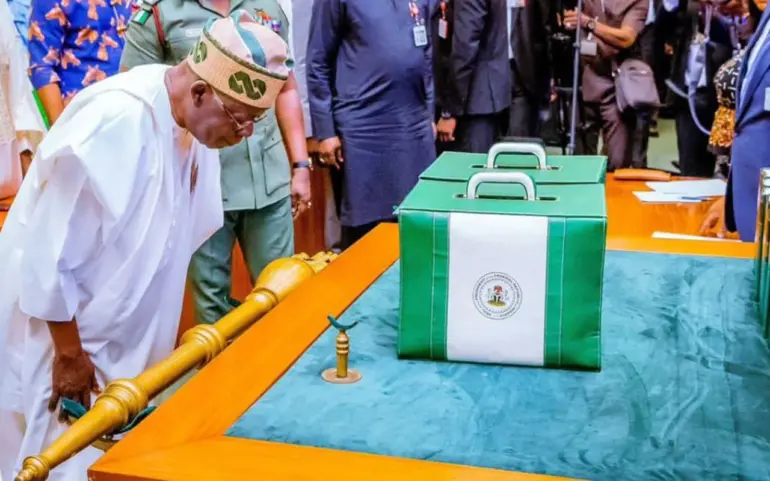
President Bola Tinubu on Friday presented a ₦58.1 trillion budget proposal for the 2026 fiscal year to a joint session of the National Assembly, outlining ambitious spending plans amid ongoing economic and security challenges.
The proposal pegs capital expenditure at ₦26.08 trillion, while recurrent (non-debt) expenditure stands at ₦15.25 trillion. The budget is benchmarked on a crude oil price of US$64.85 per barrel, daily production of 1.84 million barrels, and an exchange rate of ₦1,400 to the US dollar.
Total projected revenue is ₦34.33 trillion, with ₦15.52 trillion earmarked for debt servicing. The resulting deficit of ₦23.85 trillion represents 4.28 per cent of Gross Domestic Product (GDP).
Sectoral allocations and national priorities
Defence and security received the largest allocation of ₦5.41 trillion, reflecting the administration’s focus on tackling insecurity. Infrastructure followed with ₦3.56 trillion, while education and health were allocated ₦3.52 trillion and ₦2.48 trillion respectively.
The proposal, titled “Budget of Consolidation, Renewed Resilience and Shared Prosperity,” was described by the president as more than a fiscal document.
“These are not just accounting lines; they are a statement of national priorities,” Tinubu told lawmakers. “We remain firmly committed to fiscal sustainability, debt transparency, and value-for-money spending.”
Security as a development imperative
The budget presentation comes against the backdrop of heightened insecurity, including mass abductions and violent crimes in several parts of the country.
Reaffirming his administration’s security agenda, Tinubu said security “remains the foundation of development,” outlining plans to modernise the armed forces, expand intelligence-driven policing, strengthen border security, and deploy technology-enabled surveillance alongside community-based peacebuilding initiatives.
“We will invest in security with clear accountability for outcomes, because security spending must deliver security results,” the president said.
He added that the government would continue to boost the capacity of the armed forces and other security agencies through increased personnel strength and the acquisition of cutting-edge equipment.
Reflecting on his administration’s economic reforms since assuming office in May 2023 including the removal of fuel subsidies and the floating of the naira, both of which contributed to rising inflation, Tinubu acknowledged the hardship faced by Nigerians but insisted the economy has begun to stabilise.
“I acknowledge these difficulties plainly, and I assure Nigerians that their sacrifices are not in vain,” he said. “The path of reform is seldom smooth, but it is the surest route to lasting stability and shared prosperity.”
The president also pledged sustained investment in critical infrastructure and agriculture, describing both as strategic sectors capable of unlocking private capital and driving inclusive growth.
“We will take decisive steps to strengthen agricultural markets. Food security is national security,” Tinubu said.
According to him, the 2026 budget prioritises input financing and mechanisation, irrigation and climate-resilient farming, storage and processing, and the development of agro-value chains.
The measures, he said, are aimed at reducing post-harvest losses, improving smallholder incomes, accelerating agro-industrialisation, and building a more resilient and diversified economy.