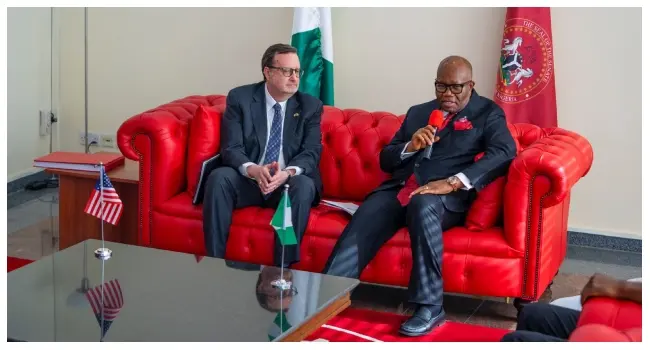
Senate President Godswill Akpabio on Wednesday received the United States Ambassador to Nigeria, Richard Mills Jr., underscoring the need to strengthen diplomatic relations between both countries.
The meeting, held at the National Assembly complex in Abuja, focused on deepening cooperation and fostering a more robust partnership between Nigeria and the United States.
Akpabio noted that Nigeria and the US share a common commitment to democratic governance, adding that Nigeria’s democratic system was modelled after that of the United States and should be nurtured and preserved.
“I thank you for visiting during the 249th Independence Anniversary of your country. Congratulations. That means you have practised democracy for 249 years. We cannot say the same in Nigeria,” Akpabio said.
“The collaboration between our countries is longstanding, and our system of government is modelled after that of the United States of America.
“One thing I know is that America has remained prosperous and has assisted many countries around the world because of its strong belief in ‘In God We Trust.’
“In Nigeria, despite our religious and ethnic diversity, we also believe that God is supreme. That is something we share in common. You are welcome to the 10th Senate of the Federal Republic of Nigeria.”
In his remarks, Ambassador Mills said the visit was intended to review the state of US–Nigeria relations and explore avenues to further strengthen bilateral cooperation.
He said the United States Mission would continue to engage with Nigeria in pursuit of shared democratic, security, and development goals, adding that the meeting also provided an opportunity to gain insight into the legislative priorities of the Nigerian Senate in the year ahead.

The meeting comes amid recent diplomatic tensions following the decision by the US government to place Nigeria on its watch list of “Countries of Particular Concern,” citing what it described as widespread persecution and killings of Christians.
Nigerian authorities have rejected the designation, arguing that the country’s security challenges including jihadist insurgency, banditry, and communal violence, affect citizens of all faiths and have been wrongly characterised as a “Christian genocide.”
The Nigerian government has also dismissed suggestions of punitive action or military intervention as unfounded and potentially destabilising, urging international partners to respect Nigeria’s sovereignty and work collaboratively to address violent extremism.