

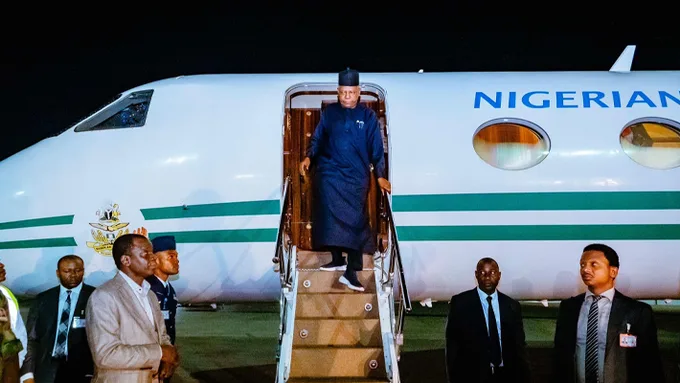
Vice President Kashim Shettima has returned to Nigeria after representing President Bola Ahmed Tinubu at the 81st Session of the United Nations General Assembly in New York, United States.
A statement issued on Monday by Stanley Nkwocha, Senior Special Assistant to the President on Media and Communications in the Office of the Vice President, said Shettima departed Abuja on September 20 with President Tinubu’s mandate to lead Nigeria’s delegation to the annual high-level gathering.
During the visit, Shettima delivered President Tinubu’s National Statement at the General Debate, where Nigeria renewed its call for reform of the United Nations Security Council, including permanent representation for Africa.
Nigeria also advocated fairer access to global financing, increased climate support for developing countries and stronger multilateral cooperation.
The Vice President participated in the Third High-Level Roundtable of the Africa Minerals Strategy Group, where President Tinubu called on African countries to move beyond the export of raw minerals and prioritise processing, manufacturing and value addition within the continent.
At a high-level education financing event co-hosted by Nigeria and Italy, Shettima reaffirmed the Federal Government’s commitment to education as a key investment in human capital, productivity and long-term national development. He also expressed support for the Global Partnership for Education’s $5 billion financing campaign.
Shettima further met with Nigerians living in the diaspora, highlighting the importance of their investments, expertise and international networks to Nigeria’s economic and social development.
Other engagements included meetings with the new leadership of the Economic Community of West African States (ECOWAS) Commission and United Nations Deputy Secretary-General Amina J. Mohammed.

According to the statement, the Vice President used the meetings and engagements to advance Nigeria’s positions on development financing, regional integration, economic cooperation, technology, peace and security.
He also reiterated the Tinubu administration’s call for a more representative and equitable global order that gives developing countries, particularly African nations, a stronger voice in international decision-making.
