

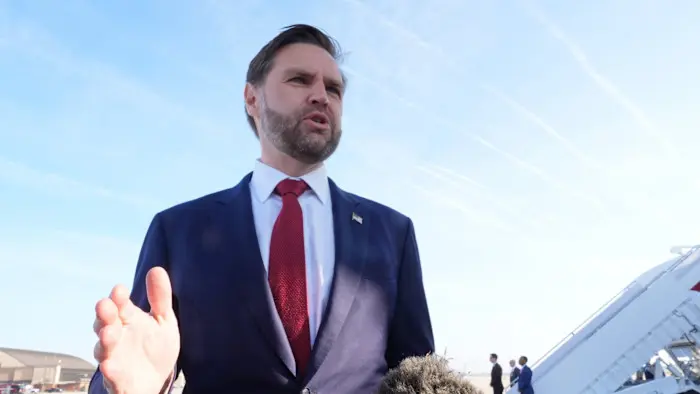
US Vice President JD Vance arrived at an airbase near Pakistan’s capital on Saturday ahead of high-stakes negotiations with Iran aimed at easing tensions and ending the ongoing conflict in the Middle East.
Vance, appointed by Donald Trump to lead the US delegation, was received by Pakistan’s army chief, Asim Munir, upon landing at Nur Khan Airbase near Islamabad.
The Iranian delegation, comprising more than 70 members and led by parliamentary speaker Mohammad Bagher Ghalibaf, had arrived earlier under tight security.
Speaking on arrival, Ghalibaf struck a cautious tone, noting Iran’s deep mistrust of past engagements with the United States. He said previous negotiations had been marked by “failure and broken promises,” despite what he described as Iran’s good intentions.
The US delegation, which includes senior adviser Jared Kushner and special envoy Steve Witkoff, also expressed guarded optimism before departing Washington.
Vance stated that the US was open to meaningful dialogue if Iran approached the talks in good faith, but warned that any attempt to undermine the process would be firmly resisted.
Iran has set key conditions for the talks, including a truce in Lebanon and the unfreezing of its assets, demands that have yet to be met.
Meanwhile, Trump has called for the reopening of the Strait of Hormuz as part of efforts to stabilise the region following a tentative two-week ceasefire. The strait, a vital route for global oil shipments, remains partially disrupted, with Trump insisting it will be reopened “with or without” Iran’s cooperation.
He reiterated that preventing Iran from acquiring nuclear weapons remains the top priority in the negotiations.
‘Make or break’ talks
Despite the ceasefire, Israeli airstrikes continued in Lebanon, targeting Hezbollah positions. Israel maintains that the US-Iran truce does not extend to Lebanon.
Israel’s ambassador to the United States, Yechiel Leiter, confirmed that discussions with the Lebanese government are expected in Washington next week, though Israel has ruled out direct ceasefire talks with Hezbollah.
Israel launched a large-scale military campaign in Lebanon following escalating tensions tied to Iran-backed attacks earlier this year. Lebanese authorities report that the conflict has claimed more than 1,950 lives, including over 350 fatalities in a single day of strikes this week.

Pakistan’s Prime Minister, Shehbaz Sharif, described the negotiations as entering a critical phase, warning that achieving a lasting resolution would be challenging.
“A temporary ceasefire has been announced, but a more difficult stage lies ahead, securing a lasting peace and resolving complex issues through dialogue,” he said, calling the moment a “make or break” point.
Security in Islamabad has been significantly tightened, with roads leading to the Serena Hotel, expected to host the talks, blocked off. The city has been visibly prepared for what officials are calling the “Islamabad Talks.”
While global markets have reacted positively, with US stocks rising and oil prices falling amid hopes of de-escalation, skepticism remains. Some observers, including residents in Tehran, doubt the talks will yield meaningful progress.
AFP
