

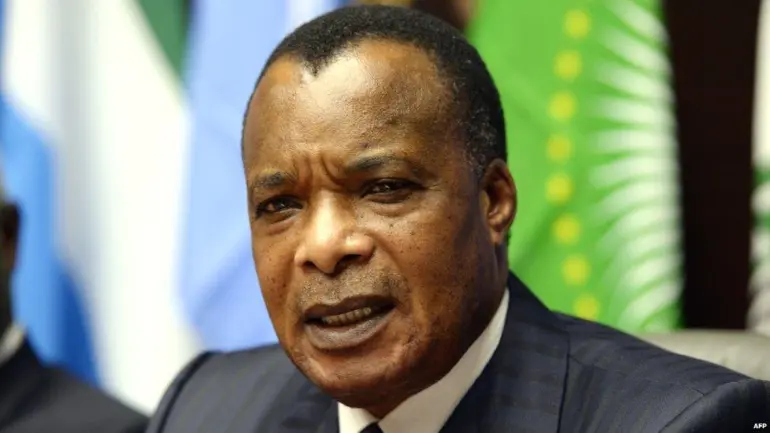
Voters were scarce on Sunday as polling stations opened in Congo-Brazzaville for a presidential election widely expected to extend 82-year-old Denis Sassou Nguesso’s more than four decades in power in the oil-rich Central African country.
Six candidates are challenging Sassou Nguesso, but the main opposition is divided and largely absent, virtually ensuring him another five-year term. The former paratrooper colonel is already one of Africa’s longest-serving leaders, alongside Equatorial Guinea’s Teodoro Obiang Nguema Mbasogo and Cameroonian President Paul Biya.
Observers say voter turnout could reach a record low.
During the campaign, which ended Friday, Sassou Nguesso toured the country under the banner of the ruling Congolese Workers’ Party (PCT), urging citizens to head to the polls. Yet at one polling station in Brazzaville’s Ouenze district, only a handful of ballots were in the box at 9:00 a.m. local time (0800 GMT). Several other stations had not received all election materials by the official 7:00 a.m. opening time.
The few voters present mostly declined to be filmed or named. One elderly woman said simply: “Denis Sassou will win.” Georgine, who admitted to working for the ruling party, added: “It’s normal for a citizen to vote for President Denis Sassou Nguesso; he’s the one who will bring peace.”
Sassou Nguesso focused on security in his final campaign rally on Friday, attended by thousands of supporters. While he can claim to have brought relative stability, human rights groups regularly denounce the persecution of opposition activists. Two prominent figures from the 2016 election campaign, General Jean-Marie Michel Mokoko and Andre Okombi Salissa, remain imprisoned with 20-year sentences for allegedly threatening internal security.
On the economic front, Sassou Nguesso highlighted his efforts to modernize infrastructure and develop the gas and agriculture sectors to make Congo self-sufficient. Oil and gas account for the bulk of state revenue, supporting a growth estimate of 2.9 percent for 2025. Despite this, more than half the population lives below the poverty line, and critics argue that massive state oil revenue has been siphoned into officials’ bank accounts. The government has faced several criminal investigations abroad, notably in France.
Although Sassou Nguesso’s re-election appears certain, the constitution prevents him from running in 2031, raising questions about succession. He told AFP he would not remain “in power forever” and that the younger generation would eventually take over, without naming a potential successor.
Sassou Nguesso first led Congo-Brazzaville under a one-party system from 1979 to 1992, lost the first multi-party elections, then returned to power after overthrowing the elected president in a 1997 civil war. He has since been re-elected in 2002, 2009, 2016, and 2021 in contests the opposition says were neither transparent nor democratic.
The former French colony, independent since 1960, has traditionally maintained close ties with both France and Russia. Congo-Brazzaville is the third-largest oil producer in sub-Saharan Africa, with hydrocarbons accounting for more than three-quarters of export earnings.
Polling stations are scheduled to close at 6:00 p.m. local time.