

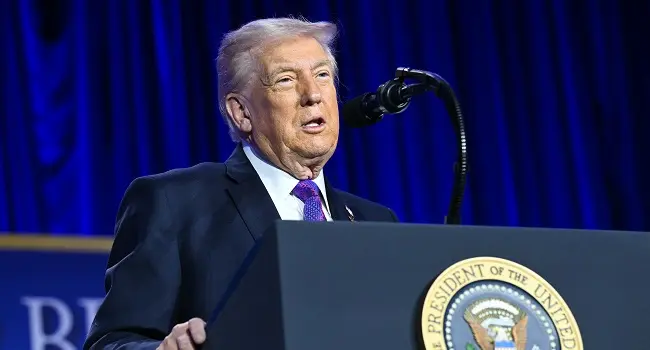
The United States on Wednesday announced new investigations into what it describes as unfair trade practices by dozens of countries, a move that could lead to additional tariffs as President Donald Trump seeks to replace duties previously struck down by the Supreme Court.
US Trade Representative Jamieson Greer said the Trump administration is launching two separate probes, one focused on global overproduction and another on the importation of goods produced with forced labor.
The excess industrial capacity investigation targets major economies including the European Union, China, Japan, and India, and could heighten tensions with key trading partners.
Greer noted that many of the countries under investigation have already reached tariff agreements with Washington, but stressed that those deals are “independent” of the new probes.
He added that Trump’s trade policy has remained consistent for decades, even if the methods used to enforce it have evolved.
“We need to protect American jobs and ensure fair trade with our trading partners,” Greer told reporters. “If tariffs are necessary to achieve that, we will impose them.”
Other economies included in the excess capacity probe are Singapore, Switzerland, South Korea, Vietnam, Taiwan, and Mexico.
According to Greer, the investigation will focus on economies where the United States has evidence of structural excess capacity and large-scale manufacturing overproduction.
He did not specify whether any eventual penalties would vary by country.
A second investigation related to forced labor is expected to begin “no earlier than tomorrow afternoon” and could affect roughly 60 trading partners.
“This is not about the domestic conditions of particular countries,” Greer said. “It is about whether countries have implemented external-facing laws to prohibit the import of goods produced with forced labor.”
More investigations expected
The investigations come weeks after the US Supreme Court struck down Trump’s global tariffs, ruling that he had exceeded his authority by invoking emergency economic powers to impose duties on nearly all countries.
In response, Trump imposed a temporary 10 percent tariff on imports, which is set to remain in place until July 24 while officials work on longer-term measures to revive his trade agenda.
Greer said additional country-specific investigations are likely to follow.
He added that the administration hopes to complete the latest probes “as quickly as possible,” ideally before the temporary tariffs expire.
Both investigations announced Wednesday will be conducted by the Office of the US Trade Representative under Section 301 of the Trade Act of 1974.
The same authority was used during Trump’s first presidency to impose tariffs on Chinese imports, many of which remain in effect today.
However, Trump’s sector-specific tariffs on products such as steel, aluminum, and automobiles remain unaffected by the Supreme Court ruling.
Greer said it was too early to determine how any new penalties resulting from the latest investigations would interact with existing sectoral tariffs.
Asked how the probes might affect recent trade agreements with partners such as the European Union and Japan, Greer said the administration would take those agreements into account.
While he declined to specify future targets for investigations, he noted that Washington has concerns over issues including digital services taxes and pharmaceutical pricing policies in several countries.
The move also comes ahead of an expected meeting between Trump and Chinese President Xi Jinping in Beijing in April.
US plans 172mb oil reserve release
Separately, the US Department of Energy announced plans to release 172 million barrels of oil from the Strategic Petroleum Reserve beginning next week as the war in the Middle East continues to push up global oil prices.
The department said the release would take approximately 120 days to complete based on planned discharge rates.
In a statement posted on X, the agency accused Iran of manipulating energy markets and threatening “the energy security of America and its allies.”
AFP