

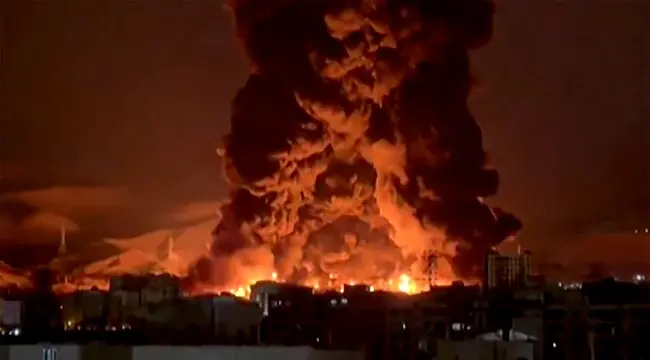
Iran was preparing to announce a successor to its slain supreme leader on Sunday, as US-backed Israeli strikes hit fuel depots in Tehran, triggering massive fires that sent thick smoke across the capital.
Nine days after the killing of Ali Khamenei in strikes on his compound, Iran’s Assembly of Experts reportedly met in a closed session to select a new leader, according to members of the clerical body.
The clerics did not disclose who had been chosen, saying only that an announcement would be made soon. Some insiders suggested that Khamenei’s 56-year-old son, Mojtaba Khamenei, could succeed his father.
Meanwhile, Donald Trump said Washington should have a say in the nomination, while Israel’s military warned that any successor would also be considered a target if hostilities continued.
Iran’s Foreign Minister Abbas Araghchi rejected the suggestion, insisting the leadership decision was solely Iran’s internal matter.
Speaking on NBC’s Meet the Press, Araghchi said Iran would “allow nobody to interfere in our domestic affairs,” and demanded that Trump apologise to the Iranian people and the region for the destruction caused by the conflict.
Israeli strikes ignite fuel depots
Israel intensified its campaign overnight with strikes on fuel storage facilities in and around Tehran, as well as an attack on a hotel in Beirut believed to house Iranian commanders.
Warplanes struck five oil facilities near Tehran, killing at least four people, according to an Iranian state oil official.
Tehran’s governor told the state-run Islamic Republic News Agency that fuel distribution in the capital had been temporarily disrupted.
A thick haze blanketed the city of nearly 10 million people, blocking sunlight and leaving the smell of burning fuel hanging in the air.
Authorities warned residents that the fumes could be toxic and urged them to stay indoors, though many buildings had their windows shattered by the force of the explosions.
“The blaze has been burning for more than 12 hours. The air has become unbreathable,” a 35-year-old Tehran resident told AFP via text message.
Missile and drone strikes continue
As the conflict entered its ninth day, Iran’s Islamic Revolutionary Guard Corps said it had enough supplies to continue missile and drone attacks across the region for up to six months.
Several explosions were heard over Tel Aviv after Israel’s military reported detecting a barrage of Iranian missiles.
Israel’s emergency service Magen David Adom said six people were wounded in central Israel.
Iranian officials also warned that more advanced weapons could soon be deployed. Guards spokesman Ali Mohammad Naini said Iran had so far used only first- and second-generation missiles but could soon deploy longer-range and more sophisticated systems.
Regional tensions escalate
The conflict has also spilled into neighbouring countries.
Saudi Arabia said it intercepted drones targeting sites including the diplomatic quarter in Riyadh. Kuwait reported damage to fuel tanks at its international airport, while Bahrain said a desalination plant had been struck.
Iran’s health ministry said at least 1,200 civilians had been killed and around 10,000 wounded in the fighting, though the figures could not be independently verified.
In Lebanon, the health ministry reported that Israeli air strikes had killed at least 394 people over the past week, including dozens of women and children.
Israel’s military said two of its soldiers had been killed during fighting in southern Lebanon.
No clear end to the conflict
Analysts warn there is still no clear path to ending the war, which US and Israeli officials say could last several more weeks.
Trump suggested Iran’s economy could eventually be rebuilt if a leader “acceptable” to Washington replaced the late supreme leader.
Meanwhile, major powers including China and Russia have largely avoided direct involvement despite their close ties with Tehran.
China’s top diplomat Wang Yi said the war “should never have happened,” warning that “the world cannot return to the law of the jungle.”
Appealing for peace, Pope Leo XIV prayed on Sunday that “the roar of the bombs may cease, the weapons may fall silent, and space for dialogue may open.”
AFP