

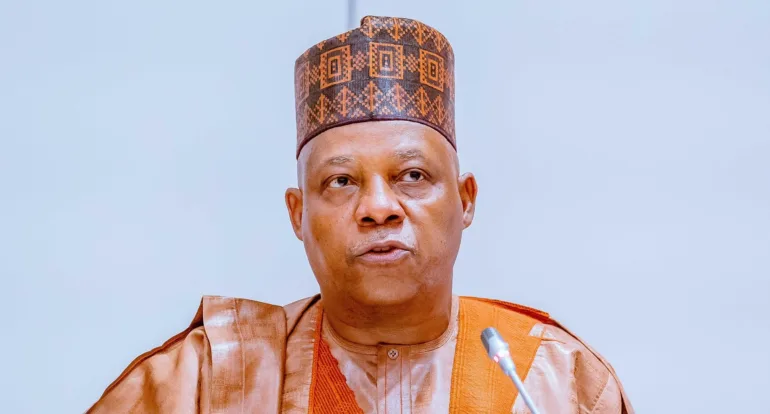
Vice-President Kashim Shettima has criticised the African Democratic Congress (ADC) over irregularities in its digital membership registration exercise, taking aim at the opposition party after it previously advocated for electronic transmission of election results.
Shettima made the remarks on Wednesday during an interfaith breaking of fast attended by federal ministers and hosted by President Bola Tinubu.
The Vice-President alleged that the ADC’s online membership portal was overwhelmed by “fictitious” entries shortly after it went live.
“The same alliance for democratic confusion that insisted on electronic transmission of votes opened their portal for new member registration, and it was flooded with fake names and fictitious identities,” Shettima said.
He added: “You and I know, but as Winston Churchill said, truth is so precious that it has to be surrounded by a bodyguard of lies. Lies, lies, lies are what is driving the opposition in this country.”
Shettima also dismissed claims that opposition governors were coerced into joining the ruling All Progressives Congress (APC).
“The political season is approaching. Nobody forced the governors of Rivers, Delta, Akwa Ibom, Kano, Adamawa, Taraba, or Enugu to join the APC. It was their own decision because they have seen the light,” he stated.
The ADC launched its nationwide online membership registration on March 1 in preparation for the 2027 general elections, in line with the amended Electoral Act. Existing members were also asked to update and validate their records according to the Independent National Electoral Commission (INEC) guidelines.
However, the exercise reportedly faced irregularities, including incorrect details, fake names, mismatched photographs, and invalid National Identification Numbers, raising concerns about the integrity of the process. The party later issued a statement confirming that the anomalies had been corrected.
The development comes amid ADC criticism of INEC’s revised timetable for the 2027 elections, released after the enactment of the Electoral Act 2026.
The party warned that the new schedule and legal requirements could make it “almost impossible” for opposition parties to field candidates. In an interview with Channels Television, ADC National Publicity Secretary Bolaji Abdullahi said the party’s objection stems from the Electoral Act 2026 itself.
“The law requires political parties to submit a fully digitalised membership register across all 36 states within a limited timeframe when notifying INEC of their congresses or conventions. This is almost impossible for us to achieve in the given period,” Abdullahi said.

He further alleged that the ruling APC has a significant advantage. “The APC started its membership registration in February 2025 and even hired a consultant to develop a digital register ahead of the 2027 elections. What took them more than a year, we are expected to do in just one month,” he said.
According to Abdullahi, these requirements amount to deliberate obstacles designed to weaken opposition participation. “Failure to comply means we may not be able to field candidates. It’s all part of the game plan,” he added.
Revised timetable
INEC recently revised the 2027 election timetable following the passage of the Electoral Act 2026. Presidential and National Assembly elections will now be held on January 16, 2027, while governorship and state assembly elections are slated for February 6, 2027, moved earlier to avoid overlapping with Ramadan.
Key pre-election activities include party primaries from April 23 to May 30, 2026. Campaigns for presidential and National Assembly elections will begin on August 19, while governorship and state assembly campaigns commence on September 9. Campaigns must end 24 hours before each election.
INEC also shifted the Osun State governorship election from August 8 to 15, while other electoral activities in Osun and Ekiti states will proceed according to the new law. Opposition parties have warned that the compressed timeline could affect preparations and competitiveness ahead of the 2027 polls.