

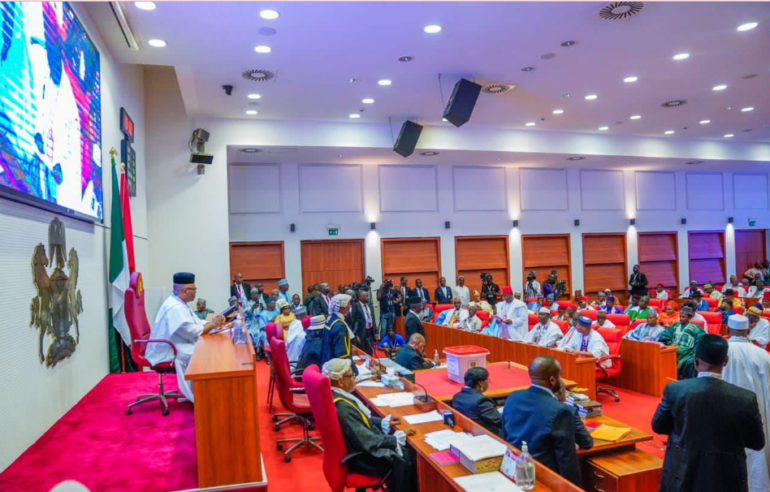
The Senate on Tuesday passed the Electoral Act, 2022 (Repeal and Re-Enactment) Bill, 2026, following tense deliberations and a heated debate over Clause 60, which addresses the electronic transmission of election results.
Proceedings turned rowdy after Senator Enyinnaya Abaribe (ADC, Abia South) demanded a division on Clause 60, prompting sharp exchanges in the chamber.
Senate President Godswill Akpabio said he believed the request for division had earlier been withdrawn, but opposition senators immediately objected. Deputy Senate President Barau Jibrin, citing Order 52(6) of the Senate Standing Orders, argued that it would be out of order to revisit a matter already ruled upon by the presiding officer.
The submission triggered another uproar, during which Senator Sunday Karimi briefly confronted Abaribe.
Senate Leader Opeyemi Bamidele, who sponsored the motion for rescission, clarified that the earlier decision of the Senate had been nullified by the rescission motion, making Abaribe’s request procedurally valid. However, Akpabio suggested the call for division was aimed at publicly demonstrating Abaribe’s position to Nigerians.
The Senate President sustained the point of order, after which Abaribe formally invoked Order 72(1) and called for a division on Clause 60(3). He specifically opposed the provision allowing manual transmission of results where electronic transmission fails and proposed that Form EC8A should not serve as the sole basis in such circumstances.
During voting, 55 senators supported retaining the proviso permitting manual transmission, while 15 opposed it.
Earlier in the session, the Senate had rescinded its previous passage of the bill to address concerns raised by stakeholders and the Independent National Electoral Commission (INEC).
Moving under Order 52(6), Bamidele urged lawmakers to return the bill to the Committee of the Whole for reconsideration. He explained that INEC had announced February 2027 for the next general elections after consultations with National Assembly leadership.

However, concerns emerged that the proposed date could conflict with Clause 28 of the bill, which requires elections to be held at least 360 days before the expiration of tenure. Lawmakers also noted that conducting elections during Ramadan could affect voter turnout, logistics, stakeholder participation, and overall inclusiveness.
Additionally, senators flagged technical inconsistencies in the bill’s Long Title and several clauses including Clauses 6, 9, 10, 22, 23, 28, 29, 32, 42, 47, 51, 60, 62, 64, 65, 73, 77, 86, 87, 89, 93, and 143 citing issues with cross-referencing, serial numbering, and internal coherence.
After resolving the contentious provisions, the Senate proceeded to pass the bill.
