

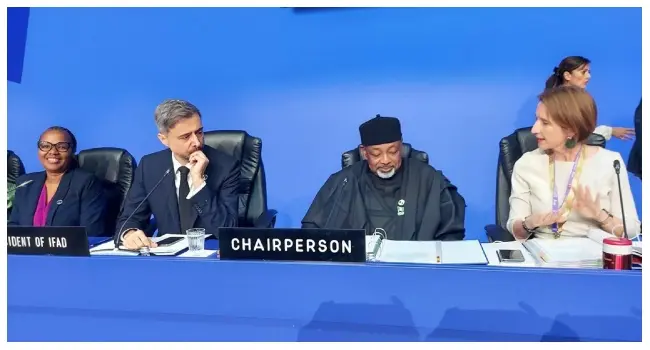
Nigeria’s Minister of Agriculture and Food Security, Senator Abubakar Kyari, has been appointed Chairman of the 49th Governing Council of the International Fund for Agricultural Development (IFAD).
Delivering his acceptance speech at the 49th IFAD Governing Council Meeting in Rome, Italy, on Tuesday, Kyari pledged to lead with impartiality, inclusiveness, and strategic foresight, emphasizing consensus-building, multilateral cooperation, and upholding the institution’s integrity.
Kyari said: “I accept this mandate not merely as a personal distinction, but as a solemn obligation to the millions of rural women and men whose hopes rest on the decisions we take in this chamber. I pledge to discharge this duty with impartiality, inclusiveness, and strategic foresight, fostering consensus, deepening multilateral cooperation, and upholding IFAD’s credibility.”
Reaffirming his commitment to IFAD’s mission, Kyari emphasized the importance of keeping the Fund financially robust, policy-driven, and impact-focused, delivering transformative outcomes for smallholder farmers, rural youth, women, and vulnerable communities worldwide.
He acknowledged the support of Nigeria’s President Bola Tinubu, Vice President Kashim Shettima, and the Federal Executive Council, crediting their vision for agricultural transformation and food security for positioning Nigeria as a global advocate for development cooperation.
Kyari also commended outgoing IFAD Chairman Christophe Schiltz for his leadership, stating: “His dedication has strengthened our collective resolve and advanced IFAD’s mission at a critical time for global food systems.”
Highlighting the role of the Governing Council as IFAD’s supreme decision-making body, Kyari stressed that its responsibilities including shaping rural transformation policies, safeguarding financial stability, appointing leadership, and approving strategic direction—require unity, discipline, and courage.

He further praised IFAD’s President Álvaro Lario, Vice President Gerardine Mukeshimana, Secretary Dr. Claudia Ten, and the Fund’s global field teams for translating policy into meaningful impact for rural communities.
Acknowledging the pressures on global food systems from climate shocks, economic volatility, conflict, and demographic change, Kyari pledged to accelerate innovation and strengthen partnerships to ensure no rural community is left behind.
“Together, we shall advance bold, forward-looking policies that empower farmers, enhance resilience, unlock rural enterprise, and secure sustainable food systems for generations to come,” he concluded, calling for collaboration among all member states to strengthen IFAD’s mandate and legacy of impact.