

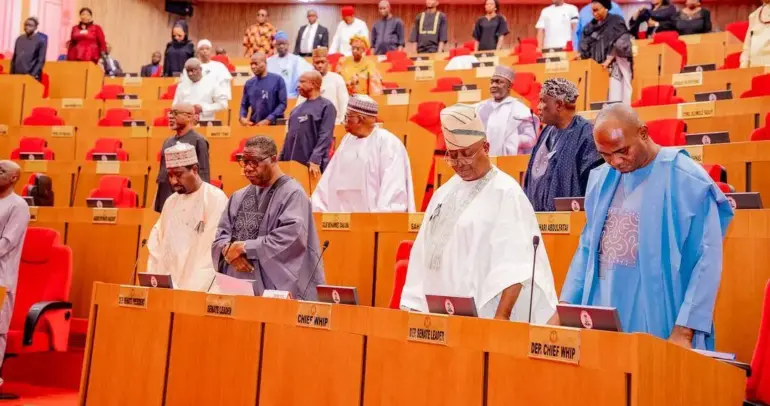
The Senate has amended the Electoral Act to permit the electronic transmission of election results, while introducing safeguards to address possible technical challenges during elections.
The decision followed the upper chamber’s move on Tuesday to rescind its earlier position that rejected compulsory electronic transmission of results from polling units to the Independent National Electoral Commission’s (INEC) Result Viewing Portal (IREV).
Under the revised provision, the Senate approved electronic transmission as a core part of the electoral process but removed the phrase “real time.” The amendment stipulates that where internet connectivity or other technical challenges arise, Form EC8A will remain the primary instrument for result collation.
According to the framework, electronic transmission will serve as the primary mode of uploading election results. However, in cases of network failure or technical disruption, results may be manually transmitted using Form EC8A, provided it is duly signed and stamped by the presiding officer.
The proposal triggered concerns among some lawmakers, particularly over the reliance on Form EC8A as the authoritative source of results in the event of disputes. The divergent views led to sharp divisions on the Senate floor, prompting Senator Enyinnaya Abaribe to call for a division vote to clearly establish the position of individual senators.
Moments later, however, Abaribe withdrew the request, and the votes and proceedings were subsequently approved and adopted by the chamber.
Senate sets up conference committee
Meanwhile, the Senate has constituted a 12-member conference committee to harmonise differences between its version of the Electoral Act (Amendment) Bill and that passed by the House of Representatives.
Announcing the decision during Tuesday’s emergency plenary, Senate President Godswill Akpabio said the committee’s membership had been expanded from nine to 12 to reflect the importance of the task.
“After consultation with the leadership, we have increased the number from nine to 12,” Akpabio said before reading out the names of the committee members.
The committee is chaired by Senator Simon Bako Lalong and includes Senators Mohammed Tahir Monguno, Adamu Aliero, Orji Uzor Kalu, Abba Moro, Asuquo Ekpenyong, Aminu Iya Abbas, Tokunbo Abiru, Niyi Adegbonmire (SAN), Jibrin Isah, Ipalibo Banigo, and Onyekachi Nwebonyi.
Akpabio urged the committee to treat its assignment as urgent, expressing optimism that the harmonisation process would be concluded swiftly.
He said the final bill would be transmitted to President Bola Tinubu within February, adding that he was hopeful the President would assent to it within the next week.
Tense plenary session
Proceedings at Tuesday’s sitting were tense, with repeated interruptions and heated exchanges disrupting debate in the Red Chamber.

The atmosphere became charged during deliberations on a motion sponsored by Senator Tahir Monguno, which sought to rescind the Senate’s earlier approval of Clause 60(3) of the Electoral Act (Repeal and Re-enactment) Bill, 2026—the provision governing the transmission of election results.
The debate culminated in Senate President Akpabio backing a revised framework that designates electronic transmission as the primary method for uploading results, while allowing manual submission through Form EC8A strictly in cases of technical failure.
Background to the controversy
Tuesday’s emergency plenary followed days of public outrage over the Senate’s earlier amendment to Clause 60(3), which removed the requirement for real-time electronic transmission and retained the 2022 Electoral Act provision granting INEC discretion over the mode of result transmission.
The decision sparked nationwide protests, including the “Occupy National Assembly” demonstration in Abuja. Civil society groups, opposition parties, and prominent political figures, among them Peter Obi and Rotimi Amaechi argued that mandatory real-time electronic transmission is critical to enhancing electoral transparency and restoring public confidence in Nigeria’s democratic process.
