

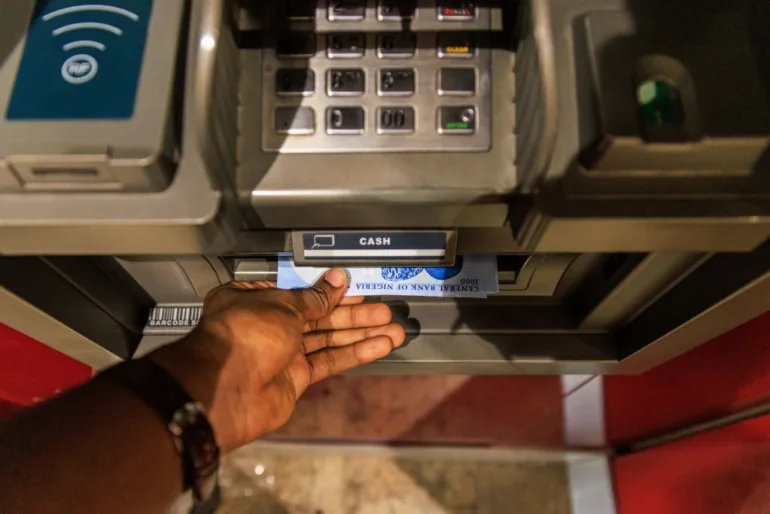
Nigerians significantly increased their reliance on cash withdrawals through Automated Teller Machines (ATMs) in the first half of 2025, withdrawing ₦36.34 trillion between January and June, almost three times the ₦12.21 trillion recorded in the same period last year.
Data from the Central Bank of Nigeria’s (CBN) quarterly statistical bulletin show that the sharp rise occurred despite a revised ATM fee regime introduced in March 2025, aimed at discouraging excessive cash usage and promoting electronic payments.
Under the new framework, the previous allowance of three free monthly withdrawals on other banks’ ATMs was removed, raising the cost of accessing cash. Customers withdrawing from another bank’s ATM now pay ₦100 per ₦20,000 withdrawn, while offsite ATMs attract additional charges of up to ₦500 per transaction.
Explaining the policy shift, the apex bank said the review was driven by rising operational costs and the need to improve efficiency in ATM services.
“In response to rising costs and the need to improve efficiency of Automated Teller Machine (ATM) services in the banking industry, the Central Bank of Nigeria has reviewed the ATM transaction fees prescribed in Section 10.7 of the extant CBN Guide to Charges,” the CBN said in a circular, adding that the changes took effect from March 1, 2025.
Despite higher charges, ATM withdrawals accelerated quarter by quarter. In the first quarter of 2025, withdrawals totalled ₦15.97 trillion, nearly three times the ₦5.46 trillion recorded in the corresponding quarter of 2024. The momentum strengthened further in the second quarter, with withdrawals rising to ₦20.36 trillion, compared with ₦6.75 trillion a year earlier.
Monthly figures show a steady climb throughout the period. Withdrawals increased from ₦4.81 trillion in January to ₦5.40 trillion in February and ₦5.76 trillion in March. The upward trend continued in the second quarter, peaking at ₦7.44 trillion in May before easing slightly to ₦6.55 trillion in June.
The surge was reflected not only in value but also in transaction volumes. ATM withdrawals rose to 858.8 million transactions in the first six months of 2025, up from 496.47 million in the same period last year, an increase of nearly 73 per cent. The figures suggest that higher fees have had limited impact on how frequently Nigerians access cash.

The sustained demand for cash has, however, drawn criticism from labour unions, consumer groups and civil society organisations. The Trade Union Congress described the fee hike as exploitative, while the Socio-Economic Rights and Accountability Project (SERAP) has challenged the policy in court, arguing that it disproportionately affects low-income earners.
Some banking industry stakeholders, however, say the increase was unavoidable given rising costs, though concerns persist over its scale and timing amid broader economic pressures.
The continued surge in ATM withdrawals contrasts with the expansion of electronic payment channels. While point-of-sale transactions remained dominant in absolute value, rising to ₦147.2 trillion in the first half of 2025, the pace of growth in ATM withdrawals was significantly faster.