

Nigeria’s headline inflation rate slowed to 15.15 per cent in December 2025, marking a continued easing of price pressures and early signs of stabilisation across key sectors of the economy.
According to data released by the National Bureau of Statistics (NBS) on Thursday, the Consumer Price Index (CPI) increased marginally to 131.2 in December from 130.5 in November, reflecting a slower pace of price increases nationwide.
On a month-on-month basis, headline inflation declined sharply to 0.54 per cent, down from 1.22 per cent in November, signalling moderation in short-term price movements. Year-on-year inflation also eased significantly from 17.33 per cent in November and was far below the 34.80 per cent recorded in December 2024, based on the revised CPI base year of November 2009.
The NBS attributed part of the moderation to a technical review of the CPI methodology, explaining that the changes were introduced to better capture current consumption patterns and improve measurement accuracy, rather than to mask economic deterioration.
Urban inflation fell to 14.85 per cent year-on-year from 37.29 per cent in December 2024, with a month-on-month increase of 0.99 per cent and a twelve-month average of 23.46 per cent. In rural areas, inflation declined to 14.56 per cent year-on-year from 32.47 per cent a year earlier, while prices fell by 0.55 per cent on a month-on-month basis. The twelve-month average rural inflation rate stood at 21.93 per cent.
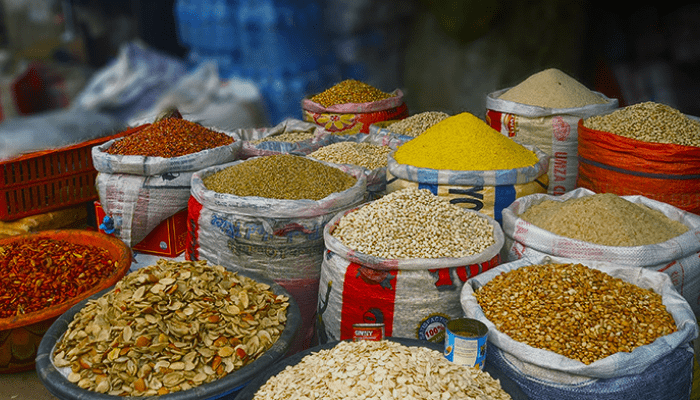
Food inflation recorded one of the sharpest declines, easing to 10.84 per cent year-on-year from 39.84 per cent in December 2024. On a monthly basis, food prices fell by 0.36 per cent, driven by lower prices of staples such as tomatoes, garri, eggs, potatoes, vegetables, plantain, beans and onions. The average annual food inflation rate for the twelve months ending December 2025 stood at 22.00 per cent.
Core inflation, which excludes volatile food and energy prices, also moderated to 18.63 per cent year-on-year from 29.28 per cent a year earlier. Month-on-month core inflation slowed to 0.58 per cent from 1.28 per cent in November, while the twelve-month average stood at 23.49 per cent.

At the state level, Abia, Ogun and Katsina recorded the highest year-on-year all-items inflation rates, while Sokoto, Plateau and Kaduna posted the lowest. Month-on-month increases were highest in Cross River, Abia and Delta, whereas Ondo, Gombe and Jigawa recorded declines.
For food inflation, Yobe, Ogun and the Federal Capital Territory recorded the highest year-on-year rates, while Akwa Ibom, Sokoto and Plateau had the lowest. Month-on-month food inflation rose most in Imo, Nasarawa and Yobe, while Plateau, Rivers and Zamfara recorded price declines.
The NBS reiterated that the revised CPI framework was designed to more accurately reflect evolving consumption behaviour and economic conditions across Nigeria.