

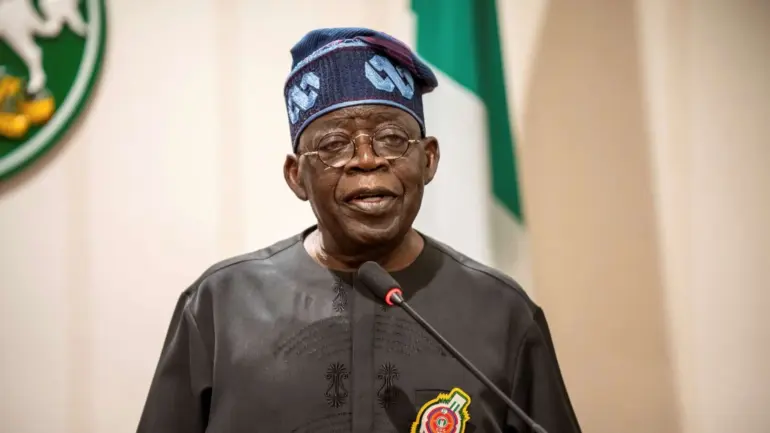
The Federal Government has said it is leveraging green finance to accelerate Nigeria’s energy transition, as President Bola Tinubu on Tuesday unveiled plans to establish a $2 billion climate fund.
Speaking at the Abu Dhabi Sustainability Week summit, Tinubu said the country’s Climate Investment Platform is expected to mobilise $500 million to support climate-resilient infrastructure projects.
He explained that the proposed National Climate Change Fund aims to achieve a $2 billion capitalisation to finance initiatives that reduce greenhouse gas emissions and strengthen climate resilience across the economy.
The president also announced that Nigeria and the United Arab Emirates have signed a Comprehensive Economic Partnership Agreement (CEPA) designed to boost trade and investment in key sectors, including renewable energy, aviation, logistics, agriculture, digital trade, and climate-smart infrastructure.
Tinubu noted that Nigeria continues to face significant environmental and climate policy challenges, particularly in reducing gas flaring and methane emissions, as it implements its Energy Transition Plan. The plan targets net-zero emissions by 2060 while ensuring universal access to energy.
He said Nigeria’s green bond programme has continued to attract strong investor interest. A ₦50 billion ($38 million) sovereign green bond issued in 2025 drew ₦91 billion in subscriptions, while Lagos State’s green bond was oversubscribed by nearly 98 per cent.
According to the president, the government is also seeking to unlock between $25 billion and $30 billion annually in climate finance. To support this effort, a new Climate and Green Industrialisation Investment Playbook has been developed to help private investors and other stakeholders navigate Nigeria’s manufacturing policies and regulatory framework.

Tinubu said these initiatives build on earlier efforts, including the Nigeria Sovereign Investment Authority’s $500 million Distributed Renewable Energy Fund launched in March 2025 to catalyse local financing for clean energy projects.
“These reforms show Nigeria is ready for business,” the president said, adding that non-oil exports have grown by 21 per cent, while investment commitments across key sectors have exceeded $50 billion.
He added that the government is prioritising technology partnerships to modernise the national power grid, deploy artificial intelligence to improve efficiency, and advance pilot projects in electric mobility and green industrialisation.