

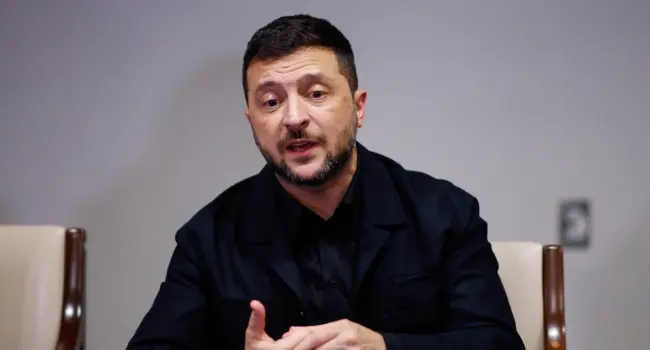
President Volodymyr Zelensky said on Tuesday that he was prepared to hold new elections in Ukraine if security could be guaranteed, adding that Kyiv would send Washington revised proposals within a day on how to end the nearly four-year war with Russia.
US President Donald Trump has been pressuring Ukraine to accept a Washington-crafted peace plan, an initial version of which was criticised by Kyiv’s allies as overly favourable to Moscow.
“We are working today and will continue tomorrow. I think we will hand it over tomorrow,” Zelensky told reporters, after days of shuttling between European capitals to coordinate a response with Western partners.
Trump, who earlier accused Zelensky of not reading the latest US proposals, told Politico that Russia currently had “the upper hand” in the conflict. He also alleged that Kyiv was “using war” as a pretext to avoid elections, which have been constitutionally suspended under martial law since Russia’s 2022 invasion.
“You know, they talk about a democracy, but it gets to a point where it’s not a democracy anymore,” Trump said.
Under Ukrainian law, elections cannot be held during martial law; without that restriction, a presidential vote would have been held in March 2024.
But on Tuesday, following Trump’s remarks, Zelensky said he was ready to organise a new ballot.
“I am ready for the elections,” he said, adding that he had asked lawmakers to propose “changes to the legislative foundations and the election law during martial law.”
He stressed, however, that no vote could take place without strong security guarantees, as Ukrainian cities face daily Russian drone and missile attacks.
“I am now asking, and I say this openly, for the United States — possibly together with our European colleagues — to help ensure security for holding elections,” Zelensky said.
‘No legal right’
Zelensky has spent recent days consulting European leaders in London, Brussels and Rome as Kyiv finalises its position on the US plan. On Tuesday he met Pope Leo XIV and Italian Prime Minister Giorgia Meloni.
Washington’s proposals reportedly call on Ukraine to surrender territory Russia has not yet seized — including the entire industrial Donbas region — in exchange for security assurances that fall short of Kyiv’s long-term aim of joining NATO.
Zelensky said Monday that the 28-point US plan had been trimmed to 20 points after weekend discussions between Washington and Kyiv. He identified territorial concessions and security guarantees as the chief sticking points.
“Do we envision ceding territories? We have no legal right to do so under Ukrainian law, our constitution or international law. And we don’t have any moral right either,” he said.
“The key is to know what our partners will be ready to do in the event of new aggression by Russia. At the moment, we have not received any answer to this question.”

Russian President Vladimir Putin, speaking in a televised appearance on Tuesday, reiterated his claim that the eastern Donbas region constitutes Russia’s “historical territory.”
“This territory is important; it is our historical territory, absolutely,” he said.
Trump criticises Europe
Trump has taken an erratic approach to Ukraine since returning to office in January, alternately scolding Zelensky for insufficient gratitude and expressing frustration that his attempts to convince Putin to halt the war have failed. He recently imposed new sanctions on Russian oil firms.
European leaders have continued to voice strong support for Kyiv. But in his Politico interview, Trump criticised Europe’s contribution, saying: “They talk but they don’t produce.”
After meeting Zelensky, Pope Leo XIV pushed back against such rhetoric, warning that remarks designed “to break apart” Europe’s unity were dangerous.
He said excluding Europe from any peace negotiations would be “unrealistic,” adding: “The war is in Europe, and Europe must be part of the security guarantees we are seeking today and in the future. Unfortunately, not everyone understands this.”
AFP
