

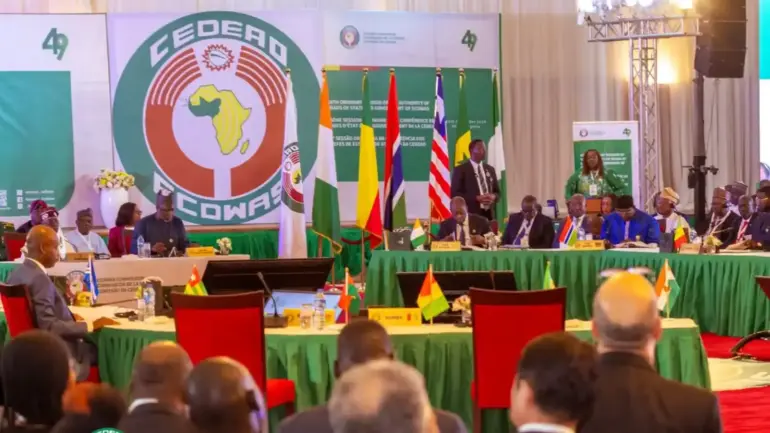
The Economic Community of West African States (ECOWAS) has declared a state of emergency across the region, citing escalating political instability, resurgent coups, and deepening security threats.
The announcement was made on Tuesday by the President of the ECOWAS Commission, Omar Touray, during the 55th Session of the Mediation and Security Council at the ministerial level in Abuja.
Touray warned that recent events highlight “the imperative of serious introspection on the future of our democracy and the urgent need to invest in the security of our community.” Addressing ministers, diplomats, and senior officials, he painted a stark picture of West Africa’s deteriorating political and security landscape, noting that country-by-country assessments indicate an average rating of “high risk” across the region.
He listed persistent military interventions including the recent coups in Guinea-Bissau and the attempted coup in Benin — non-compliance with transition timelines in Guinea, increasing political exclusion, expanding terrorist activity, and mounting geopolitical pressures as key drivers of instability.
“Elections have become a major trigger of instability in our community,” he warned, adding that the region must urgently strengthen coordination to confront terrorism, criminal networks, and cross-border insecurity. Ongoing dialogue with the Alliance of Sahel States (AES) comprising Mali, Niger, and Burkina Faso also requires renewed focus, he said.
Declaring the situation unprecedented, Touray stated: “Faced with this situation, Excellencies, it is safe to declare that our community is in a state of emergency.”
He called for more frequent meetings of the Mediation and Security Council over the coming year and outlined priority areas including the crisis in Guinea-Bissau, political transitions, rising electoral exclusion, and the need to protect regional unity.
Touray also drew attention to worsening humanitarian conditions. Citing UNHCR data, he said that as of October 2025, West Africa hosts about 7.6 million forcibly displaced people, including more than 6.5 million internally displaced persons — with Nigeria, Burkina Faso, Niger, and Mali accounting for the largest numbers.
Despite the challenges, he pledged continued commitment to regional citizens: “We will continue to work harder to promote a peaceful, stable and stronger region for the overall benefit of Community citizens.”
He urged member states to uphold constitutional norms and welcomed newly appointed ministers attending their first session, including Nigeria’s Defence Minister, retired General Christopher Musa, and Cabo Verde’s Foreign Minister, José Luis Livramento.
Sierra Leone’s Minister of Foreign Affairs and Chair of the Council of Ministers, Timothy Kabba, also called for decisive action to safeguard democratic governance. Citing the recent coup in Guinea-Bissau and the attempted coup in Benin, he described them as “sobering reminders of the fragility of our democratic gains.”
Kabba recounted his recent mission to Guinea-Bissau, where he led a high-level delegation on December 1, 2025, to engage with military leaders and political stakeholders. He said the intervention helped ease tensions, underscoring ECOWAS’s stance that coups “undermine everything our community stands for.”
“Our people no longer have patience for commitments that remain unfulfilled,” Kabba said. “They expect us to confront these challenges with seriousness, unity and purpose.”
The Mediation and Security Council meeting precedes the summit of ECOWAS Heads of State and Government, who are expected to consider the Council’s recommendations amid rising pressure to restore order across the region.
According to The Telegraph, West Africa is facing escalating political crises, with several ECOWAS states experiencing coups, attempted coups, and fragile transitions. Mali, Niger, and Burkina Faso remain under military rule, while Guinea-Bissau recently joined the list after a military intervention. The failed coup in Benin on Sunday further underscores the erosion of democratic norms and the growing reach of armed groups and criminal networks across the region.